Somewhere a founder is paying $263 a month across Claude, ChatGPT, Perplexity, and Obsidian Sync, and a used graphics card plus a $60 motherboard could be doing most of that work for the price of the electricity.
This is not a "buy a sealed box" article. This is the build: real used-GPU prices, a real parts list, the real breakeven math against your actual subscription stack, and the exact prompts that turn the finished machine into a background employee instead of a space heater.
The subscription stack nobody adds up
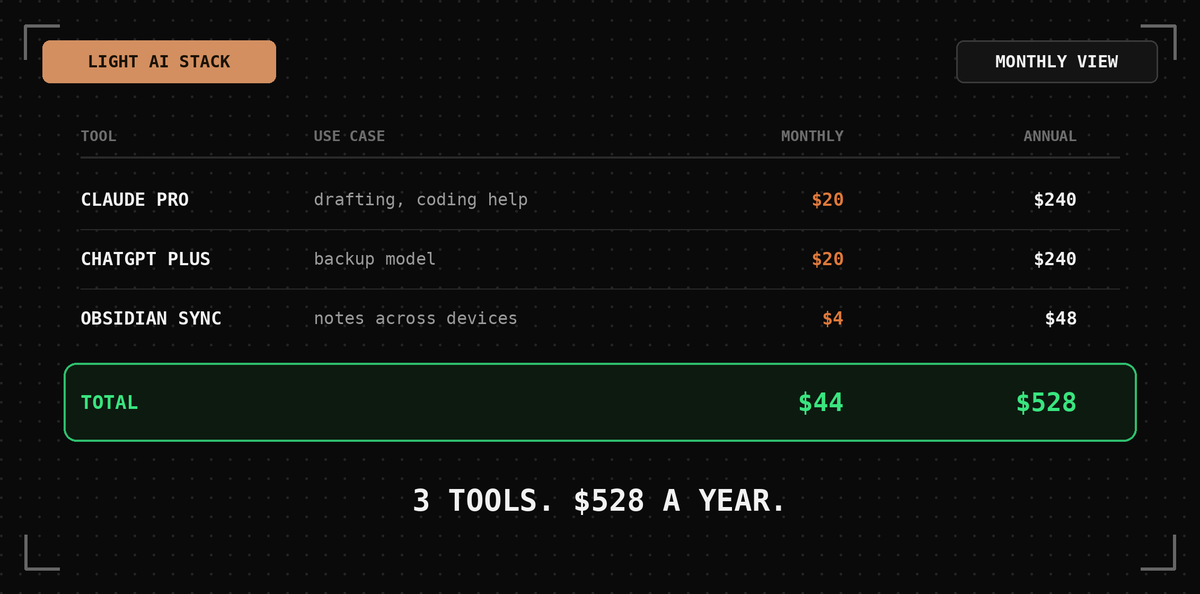
Light stack (occasional use):
RUN AT: every morning, 7 AM
WATCH: new files in /raw/receipts

STEPS:
1. Extract vendor, amount, date, category from each new receipt.
2. Check /wiki/expenses for the matching month's ledger note.
3. Append the line item; flag anything over $500 for manual review.

CHECK: every entry must cite the source filename. No source,
no entry.
STOP: all new files processed, or 3 retries on one file before
it is flagged for me directly.
Moderate stack (daily driver, 1 founder):
# Tier 1 / Tier 2, single 24GB card:
ollama pull qwen2.5:32b

# Tier 3, dual-GPU, 48GB combined:
ollama pull llama3.1:70b-instruct-q4_0
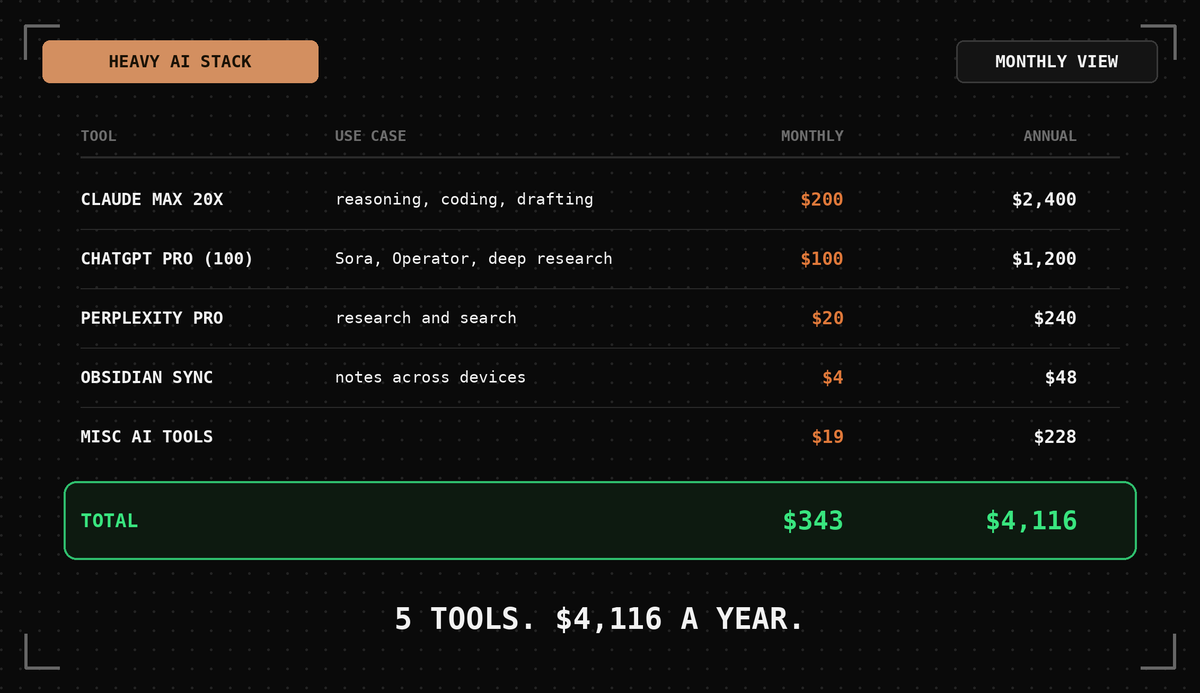
Heavy stack (agency-style solo operator):
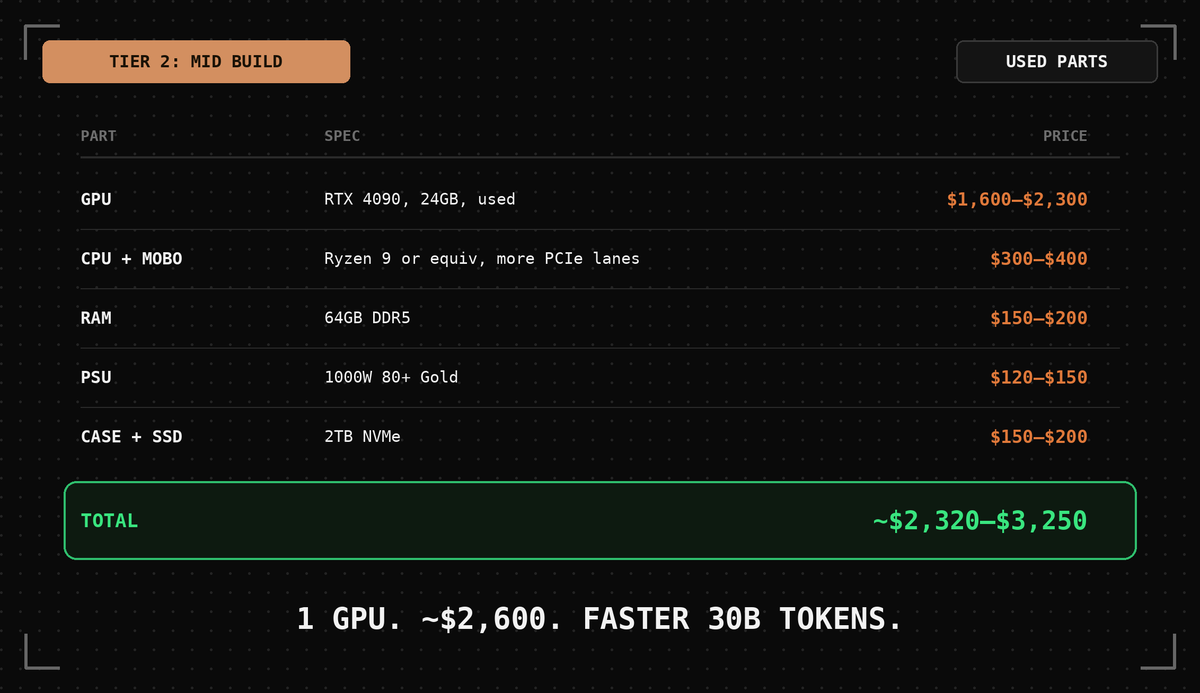
The moderate stack, $263 a month, is the one most solo founders actually run. It is the number the rest of this math is built around.
Why build instead of buy
A sealed appliance like a Mac mini is fast to set up and silent, but it is also a ceiling you cannot raise. The memory is soldered. The GPU is fixed. When a bigger model drops next year, the box does not get bigger with it.
A GPU you bought yourself has 3 things a sealed box never will: a VRAM number you chose on purpose, a PCIe slot you can add a second card into, and a resale value that holds because the part is a commodity, not a SKU. The used-GPU market exists specifically because gaming cards and AI-inference cards are the same silicon, and the AI side of that market has driven demand hard enough that a 3-year-old flagship still holds most of its value.
The parts list, 3 real tiers
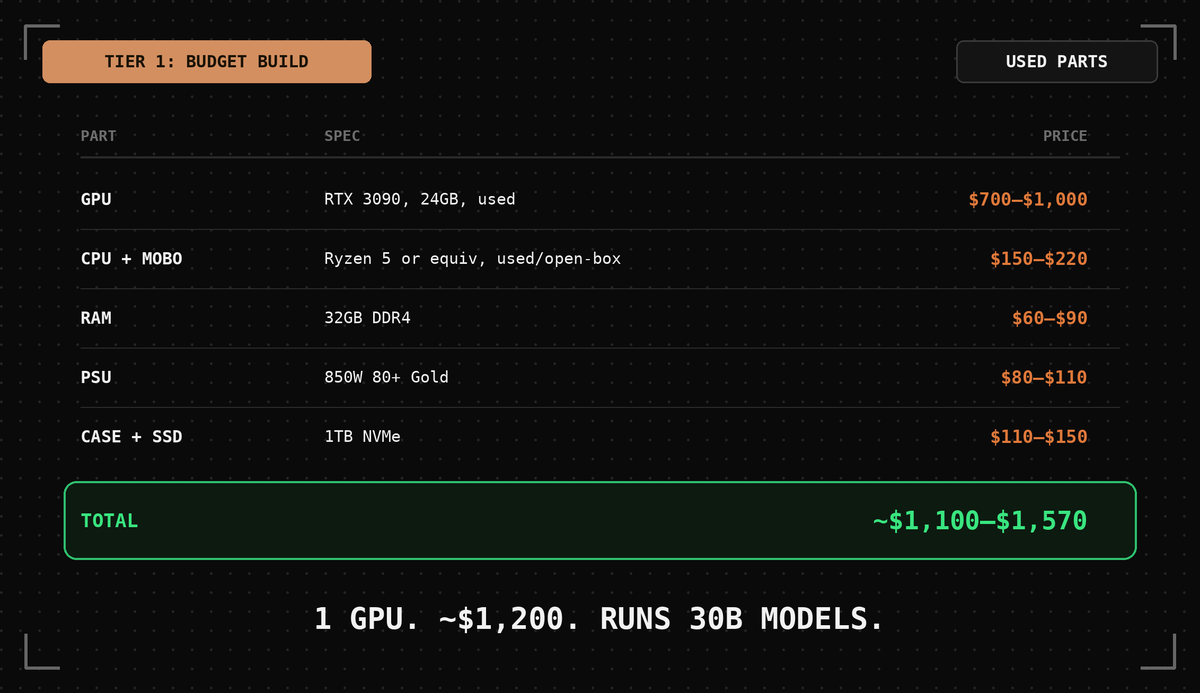
Prices below are used-market ranges as of July 2026. GPU prices move week to week, so treat these as the band, not a quote.
Tier 1, budget build:
HOME_SERVER.md

This machine is a background AI server for a solo founder's business.
Priority order: cost control first, then speed, then quality.

Structure:
/raw       — inbox exports, receipts, call transcripts, unprocessed
/wiki      — processed notes, organized by client or project
/drafts    — anything AI-generated that needs human approval before sending
/digests   — daily and weekly summaries, timestamped

Model routing:
- Classification, sorting, yes/no checks -> smaller local model (7B–14B)
- Drafting client replies, invoice summaries -> full 24GB-tier model
- Anything ambiguous, high-stakes, or client-facing final copy
  -> escalate to the cloud subscription, do not guess locally

Rules:
1. Nothing gets sent, filed as final, or marked complete without a
   human opening it first, except items explicitly marked routine.
2. If a task cannot be classified with a one-line, content-based
   reason, default to "needs human," never guess.
3. Log every automated action with a timestamp, the model used, and
   the GPU it ran on, so cost and time saved can both be checked
   honestly.
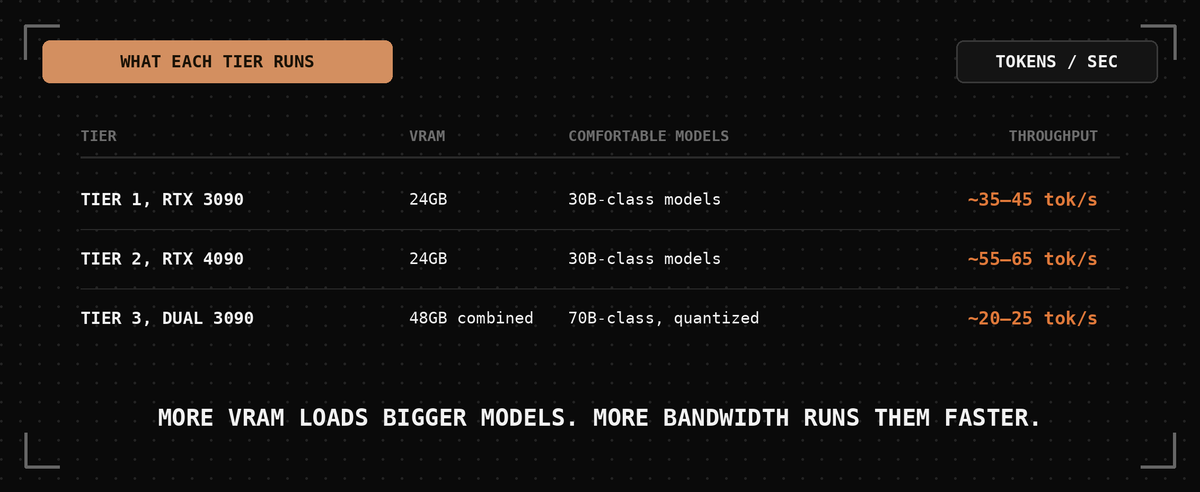
Tier 2, mid build:
client = OpenAI(base_url="http://localhost:11434/v1", api_key="ollama")
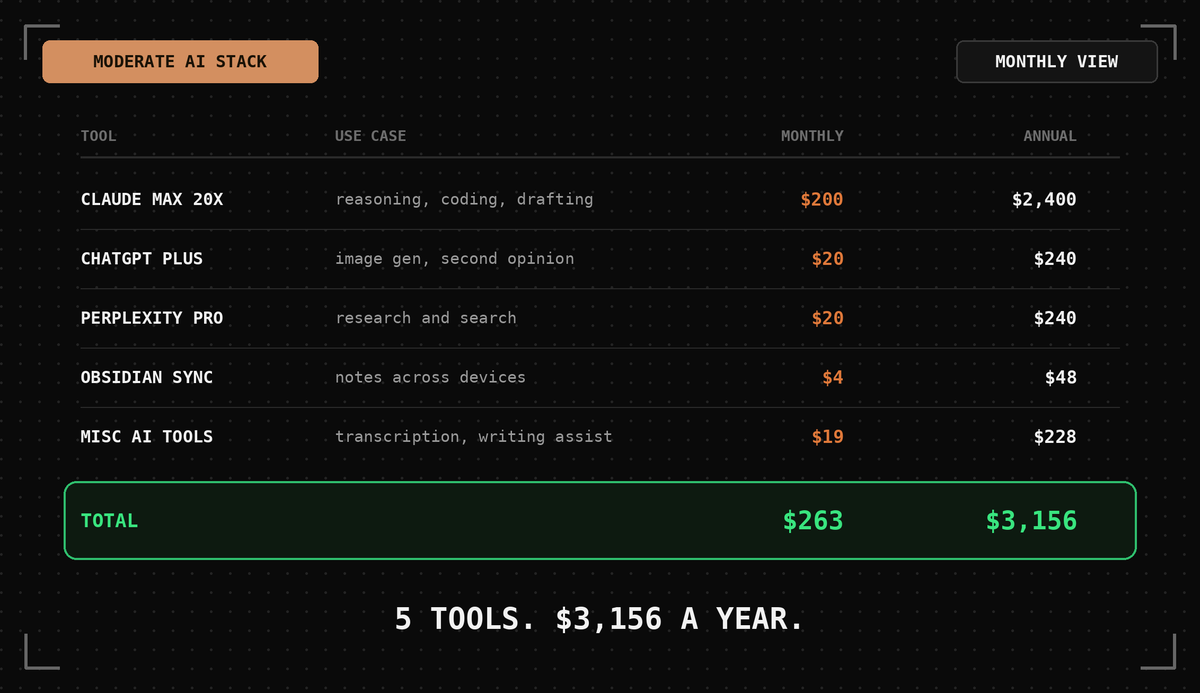
Tier 3, dual-GPU expandable:
RUN AT: every 20 minutes, business hours
WATCH: new mail in the client inbox

STEPS:
1. Pull the last 5 messages in the thread for context.
2. Classify: routine (confirms, scheduling), needs a drafted
   reply, or needs a human decision (pricing, scope, conflict).
3. Needs a reply -> draft in my voice, saved to Drafts, never sent.
4. Needs a human -> left untouched, flagged.

CHECK: draft must reference something specific from the actual
thread, not a generic template.
STOP: batch sorted, or flagged for me after 3 failed attempts
on one thread.
Electricity is the honest asterisk here, and it is the number that separates a GPU build from a sealed appliance. A Mac mini idles at 10 to 30 watts. A GPU rig idles closer to 40 to 60 watts and spikes to 300 to 450 watts under sustained inference. Blended across real usage, that lands around $8 to $20 a month depending on how hard you actually run it and your local electricity rate - budget $14/month as the middle of that range for the math below.
What each tier actually runs:
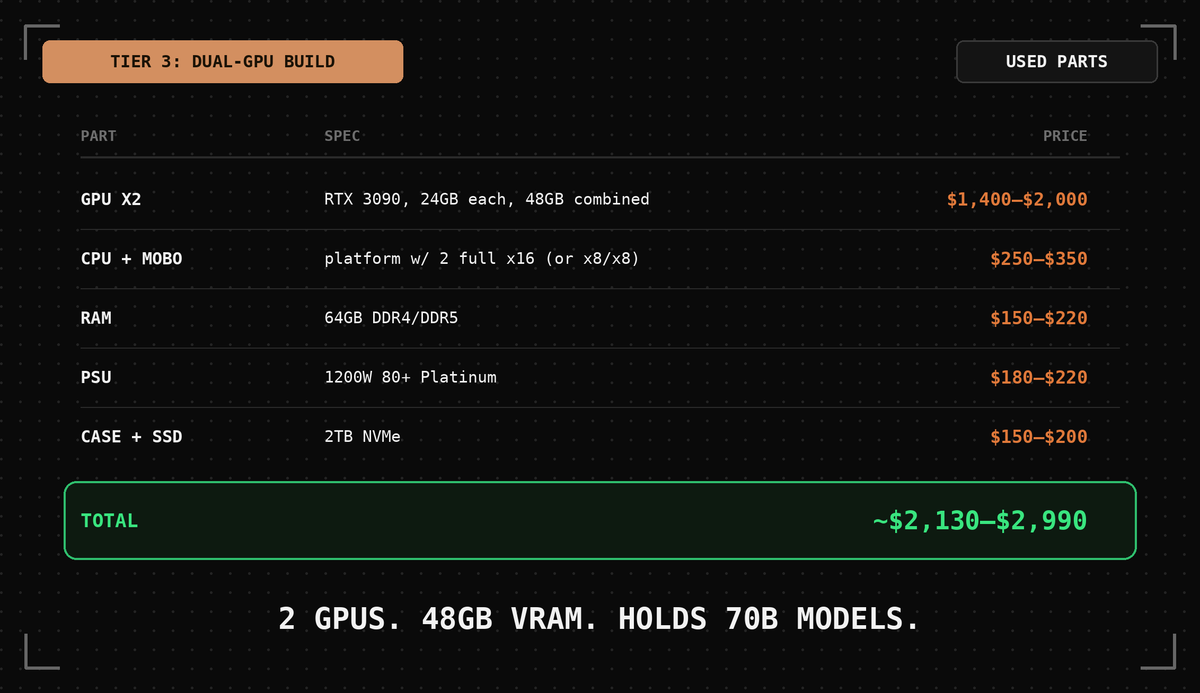
More VRAM buys you the ability to load a bigger model at all. More compute and bandwidth buy you speed once it's loaded. Tier 3's dual-card setup is slower per token than Tier 2 because splitting a model across 2 cards adds overhead, but it is the only tier here that comfortably holds a 70B-class model instead of topping out at 30B.
The breakeven math, tier by tier
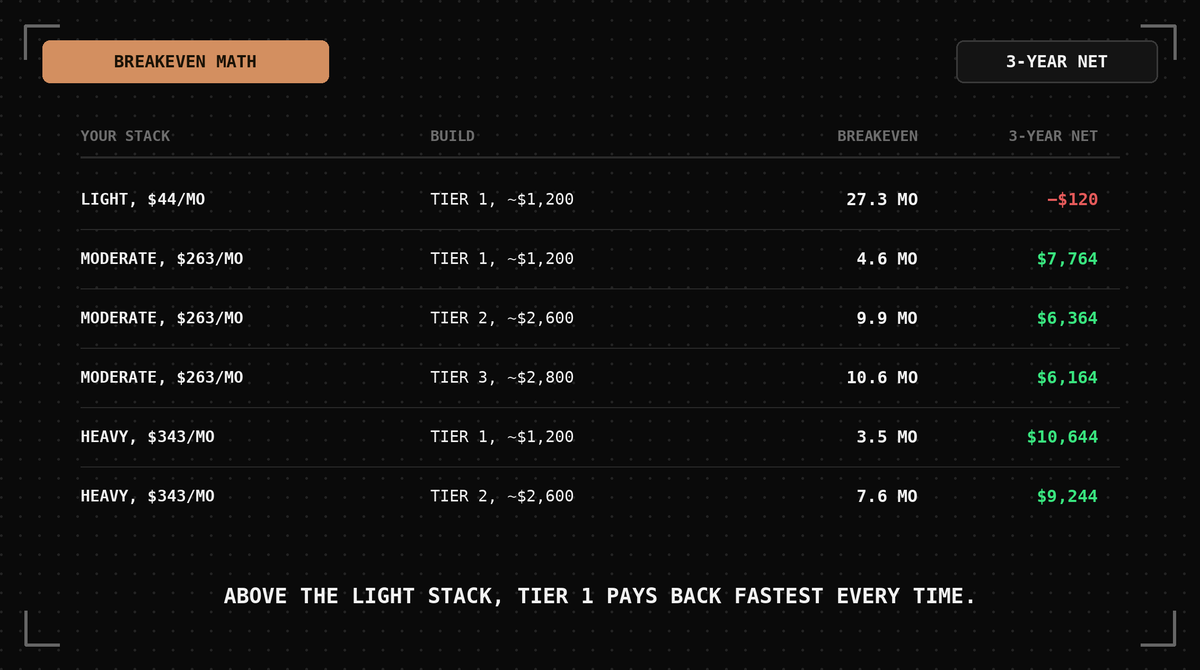
Hardware divided by monthly stack saved gives months to breakeven. Multiply the monthly saving by 36, subtract hardware and 3 years of electricity at $14/month ($504 total), and you get the real 3-year net.
# In Obsidian: Settings > Community plugins > install "Local REST API"
# Copy the generated API key, then point your local model or MCP client at:
# https://127.0.0.1:27124  (auth: the key you just copied)
Read the light-stack row honestly: at $44 a month, a GPU build never pays for itself, the electricity alone erodes what little it would save. This build only makes sense once your stack is in the moderate range or above. Above that line, Tier 1 is the best return on paper every time - Tier 2 and 3 earn their keep only if you actually need 70B-class reasoning or faster throughput, not because they save more money.
What stays in the cloud
None of this replaces the full stack, and pretending otherwise is how these builds get abandoned in a garage. Frontier reasoning, the hardest coding problems, and anything client-facing at the edge of what a model can do still belong on a hosted frontier model - keep 1 cloud subscription for that hard 20%. What moves local is the other 80%: daily drafting, note QA, classification, routine coding help, and any Obsidian-adjacent workflow currently billed through a paid plugin or API key.
Optional: expanding storage instead of buying more GPU
Once the box exists, the next bottleneck is usually not compute, it's storage for model checkpoints, embeddings, and a growing vector database as your notes and client files accumulate. An 8-bay Thunderbolt or USB enclosure - OWC's ThunderBay 8 starts around $750 diskless - adds well past 100TB of raw capacity depending on the drives you drop in, sitting next to the tower with one cable and no rack, no rent, no cloud round-trip. This is a later upgrade, not a day-1 requirement - most solo founders will not fill 2TB of local NVMe for a year or more.
The setup: 1 evening, in order
Ubuntu 24.04 with NVIDIA drivers installed, then Ollama, which turns any open model into a local API speaking the same language as OpenAI's:
curl -fsSL https://ollama.com/install.sh | sh
Pull a model sized to your VRAM tier:
Point any tool you already use at the local endpoint by changing 1 line:
Add Open WebUI in Docker for a ChatGPT-style interface, and connect Obsidian directly via its Local REST API community plugin so notes move in and out without copy-pasting:
Generate this week's digest. Pull only from /wiki items touched
in the last 7 days.

Structure:
1. 3 to 5 significant updates, linked to the full notes.
2. Any contradictions flagged this week between new and existing
   notes.
3. One line on which client or project got unusually heavy activity.

Keep the whole digest under 400 words. Save to /digests with
this week's date.
The system prompt that runs the box:
3 automations worth running on day 1
Invoice and receipt triage:
Client email drafting:
Weekly research and notes digest:
Where this breaks
Buying Tier 2 or 3 because it looks better on a spec sheet, when the moderate stack's breakeven math says Tier 1 pays back faster and nets almost as much, is the most common overspend. Skipping the instruction file and just dropping files in a folder is the most common software failure - without explicit routing rules, the box guesses, and a wrong guess on a client invoice costs more than the subscription ever did. And ignoring the electricity line because "it's just a GPU sitting there" is how a light-usage founder ends up with a $1,200 space heater that never breaks even.
The subscriptions come back every month. The box you built just sits there working.